
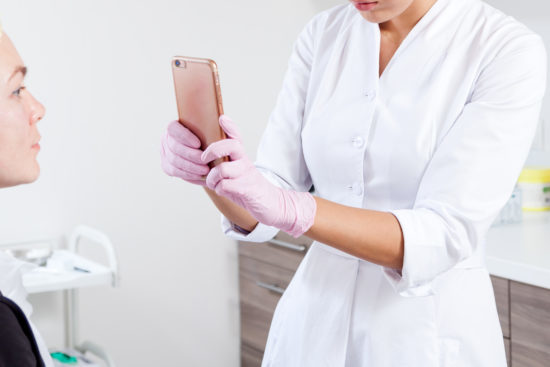
With the need to reduce outpatient attendance due to Covid-19, Ipswich and East Suffolk CCG commissioned Rego Teledermatology to create the capacity to treat patients under the supervision of their GP, with remote support from specialist consultants.
The introduction of Rego Teledermatology allowed GPs to make structured, relevant electronic referrals to consultants, supported by images, required for a meaningful assessment of patients’ skin condition.
Telederm has been literally transformational for how primary care can safely manage patients with skin lesions where there is uncertainty … Prior to this, a patient may have waited many weeks if not months for assessment leaving both patient and clinician in the limbo of doubt which causes anxiety.
Dr Crockett, GP at Peninsula Practice
Challenge
In Ipswich and East Suffolk, patients often waited several weeks or months to be seen and had to travel long distances to a hospital for appointments.
At the height of Covid-19, it also became necessary to reduce in person outpatient attendance due to risk of infection while maintaining care and support for patients.
Solution
The Vantage team worked with GPs, hospital consultants, the Trust’s IT team and commissioners to introduce Rego Teledermatology, which allows GPs to make structured, relevant electronic referrals to consultants, supported by images, required for a meaningful assessment of patients’ skin condition.
Launched directly from primary care record systems such as SystmOne or Emis, the platform captures the patient demographics and medical history from the clinical record automatically into the form. New technology developed during the pandemic enabled patient images to be uploaded remotely either through Vantage’s mobile app or by practices, with clinicians able to upload images they received via other virtual consultation platforms such as eConsult and AccuRx.
With a written referral supported by images, the consultant can offer rapid advice and guidance back to the GP without the patient having to attend the hospital, usually within 2-3 working days. The whole process is automated so the GP avoids having to undertake manual checks of referrals against complex pathway guidance.
…by triaging the routine referrals we can pick up more than 10% of skin cancers otherwise waiting to be seen as non-urgent, have been able to create a bond of trust and strengthen the interface between primary and secondary care and improve patient care by providing guidance on further management within 2 days through digital advice to GPs.
Dr Labinoti, Consultant Dermatologist at Ipswich Hospital
Results
- 47% of patients did not require a hospital appointment, saving over 350 outpatient appointments
- 12% of patients found to have suspected skin cancer were fast-tracked
- Over 800 routine advice and guidance requests for skin lesions have been received through Rego since June 2020 from GP practices
- 85% of requests received a response from the Consultant Dermatologist within 3 working days
- 39% of patients required a routine hospital appointment
- Reduced waiting time for routine dermatology outpatient appointments from 28 weeks (Feb 2020) to 17.5 weeks (December 2020)
- 13,360 patient travel miles saved
- 2,100 hours of patient time saved
Feedback from User Survey
- 100% of respondents agreed that the system has improved access to care for patients with skin lesions during Covid
- 95% of respondents were pleased with the response time and quality of advice and guidance
- 78% of respondents felt that the system supported earlier detection and intervention of previously undetected cancerous lesions